BOMBSHELL ANNOUNCEMENT: Tottenham Hotspur FC Chief executive director Vinai Venkatesham stuns entire squad with shocking Decision as manager Roberto De Zerbi publicly Rejects proposal…. See more
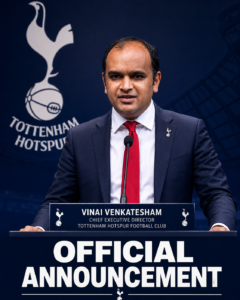
While this story is entirely fictional and created for entertainment purposes, it imagines the type of internal power struggle that can sometimes emerge at elite football clubs during periods of transition and ambition.
According to the fictional narrative, tensions began to rise behind the scenes shortly after Tottenham concluded a difficult but promising season. Despite showing encouraging signs on the pitch, the club hierarchy remained determined to accelerate progress and close the gap on their Premier League rivals.
Sources within this imagined storyline claim that Venkatesham unveiled an ambitious restructuring proposal during a closed-door meeting attended by senior coaching staff, recruitment executives, and several influential first-team figures.
The proposal reportedly centered on introducing a more centralized football model, one in which recruitment, tactical analytics, sports science, and youth development would operate under a unified executive framework. Such a model has become increasingly common among Europe’s biggest clubs.
However, in this fictional account, the proposal also included a clause that would significantly reduce the manager’s influence over transfer decisions.
That element reportedly proved to be the catalyst for one of the most dramatic disagreements in recent Tottenham history.
Roberto De Zerbi, renowned throughout European football for his strong tactical principles and uncompromising football philosophy, was said to have expressed immediate concerns.
During the fictional meeting, De Zerbi allegedly argued that limiting the head coach’s authority in transfer matters would undermine the team’s long-term sporting identity.
“Every successful team must have a clear football vision,” the imagined De Zerbi reportedly told club officials. “If the coach cannot shape the squad according to that vision, consistency becomes impossible.”
Those comments, according to this fictional scenario, were initially delivered privately.
But events escalated rapidly.
Only hours after the meeting concluded, reports began circulating that De Zerbi had publicly rejected the proposal during an informal media briefing at the club’s training complex.
The supposed rejection instantly dominated headlines across the football world.
Supporters immediately took to social media, with reactions divided.
Some fans praised the manager’s willingness to defend his principles.
Others argued that modern football requires executives and sporting departments to work collaboratively rather than granting complete control to head coaches.
Inside the dressing room, this fictional report suggests that players were equally surprised by the unfolding drama.
Senior squad members reportedly had little prior knowledge of the executive proposal and were stunned to learn that significant structural changes had been discussed without wider consultation.
Several players allegedly sought clarification from coaching staff regarding whether the disagreement would affect transfer plans for the upcoming season.
Questions quickly emerged concerning squad morale.
Would key players remain committed?
Could uncertainty impact contract negotiations?
Would transfer targets hesitate before joining the club?
These concerns only intensified as speculation surrounding the dispute continued to grow.
In this imagined narrative, club captain figures attempted to calm tensions by organizing a private players-only meeting.
The objective was simple: maintain focus on football regardless of developments occurring at boardroom level.
One senior player was fictionalized as saying:
“The squad must remain united. Decisions made upstairs cannot distract us from our objectives on the pitch.”
Football analysts across Europe also weighed in on the fictional controversy.
Many observers argued that disagreements between executives and managers are inevitable at clubs with major ambitions.
Former players appearing on television panels debated whether modern football has evolved beyond the traditional model in which managers possess ultimate authority.
Some pointed to clubs operating under sporting directors and recruitment committees as evidence that collaborative structures can produce sustained success.
Others insisted that elite coaches require significant influence to implement their tactical systems effectively.
In this fictional scenario, De Zerbi’s supporters highlighted his track record of developing players and establishing attractive attacking football.
They argued that restricting his influence would risk undermining the very qualities that convinced Tottenham to appoint him.
Meanwhile, advocates of Venkatesham’s imagined proposal claimed that executive-led recruitment reduces long-term instability.
After all, managers frequently change clubs, whereas organizational structures often remain in place for many years.
As media attention intensified, pressure mounted on Tottenham’s board to address the growing uncertainty.
A formal statement was reportedly expected.
Pundits speculated that three potential outcomes could emerge.
The first possibility involved compromise.
Under this scenario, both parties would negotiate revised responsibilities, allowing De Zerbi to retain substantial input while integrating broader executive oversight.
The second possibility involved a complete withdrawal of the proposal.
Such a move could strengthen De Zerbi’s authority but potentially weaken executive influence.
The final and most dramatic possibility involved an irreparable breakdown in relations.
Although purely fictional, such a scenario would inevitably raise questions regarding the long-term future of both individuals.
Supporters anxiously awaited clarification.
Training sessions reportedly continued as normal, yet media cameras remained stationed outside the club’s facilities.
Every player arrival, every executive appearance, and every public comment became the subject of intense scrutiny.
In this imagined story, Venkatesham eventually addressed the speculation during a press conference.
He emphasized the importance of unity and insisted that all decisions were motivated by a desire to help Tottenham compete consistently for major trophies.
“Our ambition is to build a sustainable structure capable of delivering long-term success,” the fictional statement read. “Healthy discussion is part of any elite environment.”
Shortly afterward, De Zerbi also delivered remarks intended to calm supporters.
While reaffirming his principles, he stressed his commitment to the club and its fans.
“My focus remains on improving the team every day,” the fictional manager stated. “Debate is natural in football, but everyone at this club shares the same objective.”
Those comments appeared to reduce tensions, at least temporarily.
Nevertheless, the imagined episode served as a reminder that modern football extends far beyond events on the pitch.
Today’s elite clubs operate as complex organizations involving executives, analysts, scouts, coaches, medical departments, and commercial teams.
Balancing competing perspectives can be challenging.
Yet when managed effectively, differing viewpoints can also produce stronger decisions.
Ultimately, in this fictional scenario, the future of Tottenham would depend not on boardroom disagreements but on whether leadership figures could align behind a shared vision.
Because regardless of titles, responsibilities, or internal debates, success in football still depends on unity.
And as supporters know better than anyone, unity has often been the foundation upon which great teams are built.








Post Comment