BOMBSHELL ANNOUNCEMENT: Penrith Panthers winger Brian To’o has been banned and suspended from sport activities as he was tested positive of….see more
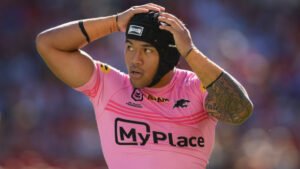
According to the fictional scenario, the club released a brief statement confirming that the player would no longer participate in team activities while an internal review reached its conclusion. Although officials declined to disclose the exact details, they emphasized that the decision was made in the best interests of the club, its players, staff, and supporters.
The announcement immediately became one of the biggest talking points across the rugby league community. Social media platforms were flooded with speculation, while sports analysts spent hours discussing the possible implications for both the player’s future and the club’s ambitions for the remainder of the season.
The unnamed winger had established himself as one of the competition’s most exciting attacking players over recent years. Known for his blistering pace, acrobatic finishes, and ability to change games in an instant, he had become a fan favorite wherever he played. His highlight reels regularly featured spectacular diving tries, long-range breaks, and match-winning performances under pressure.
Because of his impressive performances, many supporters believed he would remain a cornerstone of the club for years to come. Merchandise bearing his name sold well, young fans admired him, and coaches frequently praised his commitment during training sessions.
That is why the fictional announcement came as such a surprise.
Club officials held a brief media conference shortly after releasing their statement. The club’s chief executive stressed that professionalism and accountability remain fundamental values of the organization.
“This decision was not taken lightly,” the executive explained. “Every individual associated with this club is expected to uphold the standards we have established. While we cannot comment further because of confidentiality, we ask everyone to respect the process currently underway.”
Those carefully chosen words did little to calm speculation.
Former rugby league stars appearing on television urged supporters to avoid jumping to conclusions before all the facts became known. Several reminded fans that rumors often spread rapidly during high-profile sporting controversies and encouraged patience until official information became available.
Inside the dressing room, teammates were reportedly disappointed by the sudden development. Many had built close friendships with the winger over several seasons and were said to be shocked by the news.
One anonymous teammate described the atmosphere as emotional.
“It has been a difficult day for everyone. Regardless of what happens next, we hope the situation can eventually be resolved fairly.”
Meanwhile, the coaching staff faced an immediate tactical challenge. Losing one of the team’s fastest outside backs would require significant adjustments ahead of important fixtures. Young reserve-grade players were suddenly presented with an unexpected opportunity to prove themselves at the highest level.
The head coach acknowledged that replacing such an influential player would not be easy.
“He brings speed, experience, and confidence to our backline,” the coach said. “Whenever someone of that quality becomes unavailable, everyone else has to step up.”
Training sessions during the following week reportedly focused heavily on reshaping attacking combinations. Outside backs rotated through multiple positions as coaches searched for the most effective replacement.
Supporters reacted with mixed emotions.
Some applauded the club for demonstrating that no player is bigger than the organization. They argued that maintaining strong professional standards should always take priority over individual talent.
Others believed the decision appeared harsh without additional public information, insisting that fairness requires allowing the review to conclude before judgments are made.
Sports lawyers interviewed by television networks noted that employment matters involving professional athletes are often significantly more complex than they first appear. Contracts typically include behavioral expectations, disciplinary procedures, appeal mechanisms, and confidentiality clauses that prevent clubs from discussing specific details publicly.
If the fictional winger ultimately challenged the decision, the process could potentially involve player representatives, legal advisers, and the competition’s governing body.
For the player personally, the indefinite dismissal represented the biggest challenge of his professional career.
Athletes often define themselves through competition, daily training, and representing teammates on the field. Suddenly losing that routine can be emotionally and mentally difficult.
Sports psychologists frequently emphasize the importance of maintaining perspective during career setbacks. Whether injuries, suspensions, or contractual disputes, professional athletes often rely heavily on family members, trusted friends, and experienced advisers during uncertain periods.
Fans also expressed concern about the player’s well-being. While opinions differed regarding the club’s decision, many agreed that respectful discussion should replace online abuse and personal attacks.
Throughout rugby league history, numerous players have experienced significant setbacks before rebuilding successful careers. Some returned stronger after disciplinary issues, while others found fresh opportunities with different clubs or competitions.
Those examples served as reminders that one difficult chapter does not necessarily define an entire career.
The fictional club now faces increased scrutiny over every upcoming match. Media attention is expected to remain intense until the internal process reaches its conclusion.
Every team selection, press conference, and training update will likely generate fresh headlines as journalists seek additional information.
Sponsors are also monitoring developments closely. Modern sporting organizations recognize that public reputation plays an increasingly important role in commercial partnerships. Clubs therefore place considerable emphasis on transparency, professionalism, and protecting their long-term image.
The rugby league community has generally supported the principle that investigations should be conducted thoroughly and fairly before final conclusions are reached. League administrators have repeatedly stressed that maintaining integrity benefits players, clubs, sponsors, and supporters alike.
For younger athletes watching from academies and junior competitions, the fictional incident also highlights the importance of professionalism beyond match day. Coaches regularly remind emerging players that representing a club involves responsibilities both on and off the field.
Regardless of talent, discipline, respect, and accountability remain essential qualities for building a successful sporting career.
As the story continues to unfold, supporters will undoubtedly hope for clarity from all parties involved. Whether the winger eventually returns to professional rugby league or moves in a different direction, the outcome of the internal review will likely have lasting consequences for everyone connected with the club.
Until then, speculation will continue, but the most responsible approach is to allow the process to run its course. The fictional situation serves as a reminder that success in professional sport depends not only on performances during the eighty minutes of a match but also on maintaining the standards expected by teammates, coaches, management, and the wider rugby league community.









Post Comment